Case Study

Rumi Mirror —
verified verse
discovery

A small web app that returns verified verses of Rumi instead of AI-generated ones, designed to protect a literary heritage from misattribution and hallucination.

Role
Product Designer — research, UX, content architecture, AI system design
Timeline
August – September 2026, part-time
Context
Solo project, submitted to the World Usability Day Design Challenge 2026
Scope
30 curated verses · 10 emotional categories · no accounts
Rumi Mirror introduction: the category home beside an ornate mirror
Ethical AI Content Verification Information Architecture Solo Research & Design

The Challenge

Building Rumi Mirror wasn't one hard problem. It was several interconnected ones.

01

A concept that wasn't communicating its value

Before any code, I tested an early concept with two colleagues unfamiliar with Rumi — one in the Netherlands, one with a Japanese cultural background in Australia. Their first reaction: “I'm not clear what the solution will be… why do you care?”

02

Two audiences, two trust barriers

Newcomers needed the purpose in seconds. Readers who know the work needed accurate sourcing before they would trust it at all.

03

An AI system that had to earn trust

The obvious version lets a model write a “Rumi-style” reflection on demand. That is also the fastest way to fabricate the heritage the product exists to protect.

Illustrated portrait of the concept tester based in the Netherlands
Netherlands Colleague, unfamiliar with Rumi
Illustrated portrait of the concept tester with a Japanese cultural background, based in Australia
Australia Japanese cultural background, unfamiliar with Rumi
Persona 01 · The Skeptical Outsider

Japanese, unfamiliar with Rumi. Needs to understand what the product is and why it matters within seconds.

Persona 02 · The Devoted Reader

International, deeply familiar with Rumi. Needs accurate sourcing and interpretation before trusting the experience.

Shared need: Credibility must be visible, not merely claimed.

The real challenge wasn't building an AI feature. It was designing constraints that kept the AI from ever inventing text on a literary heritage it wasn't authorized to speak for.

My Approach

How I navigated the complexity

Step 01

Test the concept before building

Reframing the idea around ethical AI turned confusion into clarity. The same reviewer went from “why do you care?” to “This I get. This is crystal clear.” — Vlad, concept reviewer

Step 02

Validate the problem with people who live it

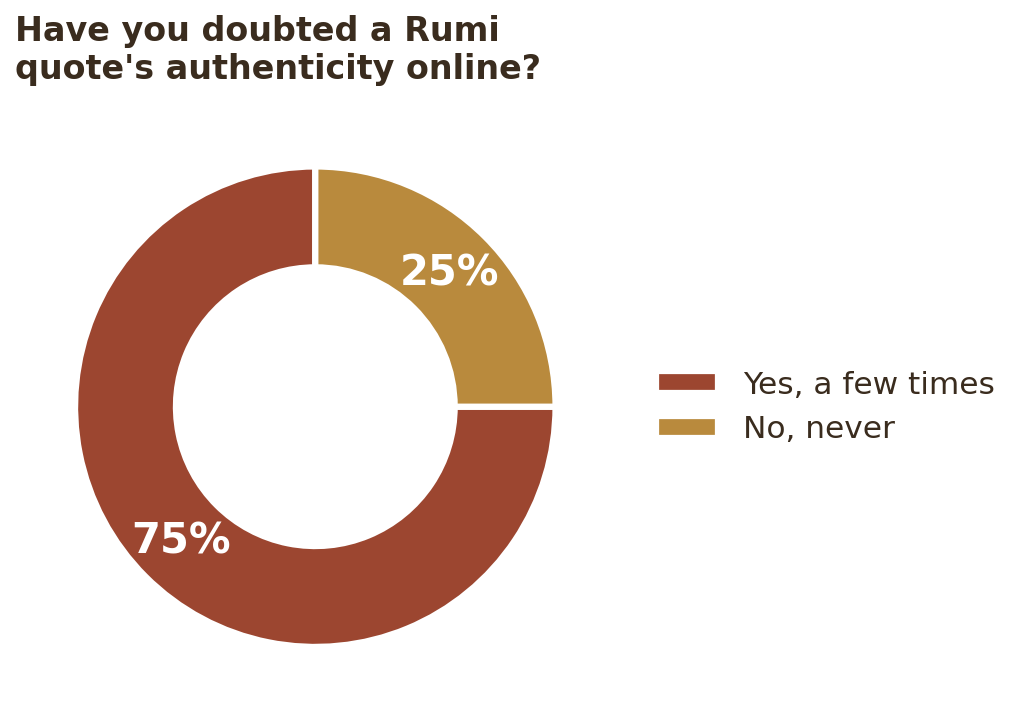
A Rumi study group (n=4) was asked how they find verses and whether they had doubted a quote online. 3 of 4 had. The trust problem was not hypothetical.

Step 03

Design the guardrails before the interface

Four rules the product would not break: retrieve, never generate; public-domain sourcing only; human-authored reflection; a structured emotional taxonomy instead of an open prompt.

Survey chart: 75% of the Rumi study group have doubted a quote's authenticity online, 25% never have
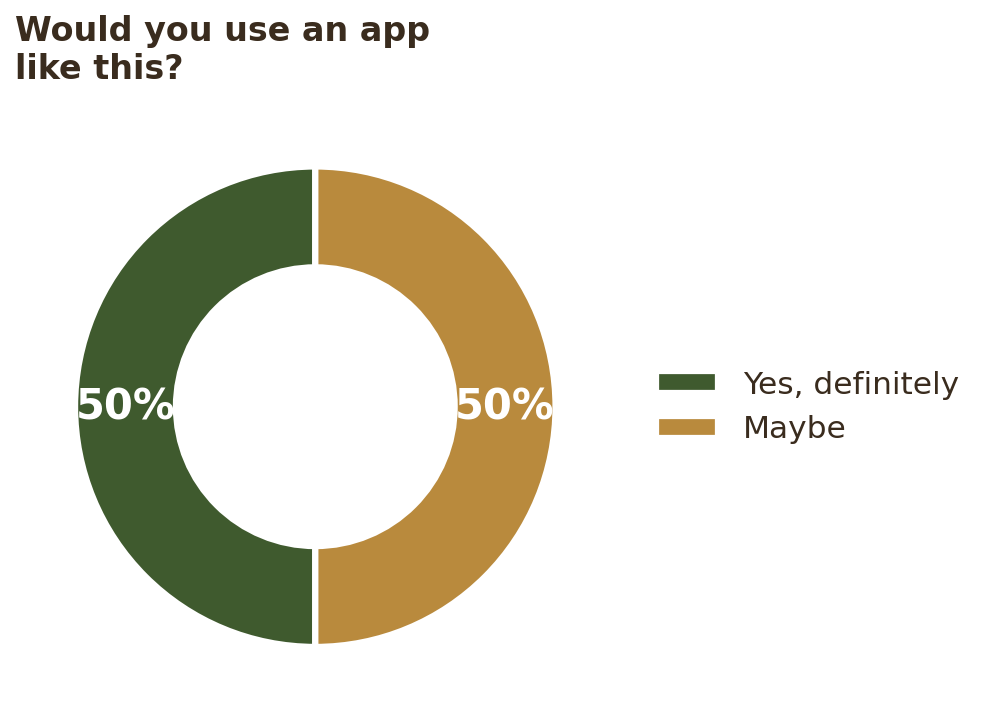
Survey chart: 50% of the Rumi study group would definitely use an app like this, 50% said maybe

Results from the Rumi study group survey (n=4) referenced in Step 02.

Key Decisions

Why each design decision was made

01

Retrieval, not generation

A model that composes “Rumi-style” text will eventually present something Rumi never wrote, with full confidence. Restricting the system to a fixed, curated set removes that failure mode.

02

A taxonomy, not free text

Free-text emotional input felt arbitrary and read like a generic chatbot. Ten emotional categories give a clear starting point and keep matching constrained.

03

Nicholson's translation

Popular English translations of Rumi carry copyright restrictions. Reynold A. Nicholson's Mathnavi is public domain, so the product can be shared without adding another unclear source.

04

A standalone Verify feature

People also want to check quotes they have already seen. Verify returns one of five outcomes: Confirmed, Confirmed partial, Confirmed multiple, Close but not exact, or Not found.

The biggest challenge wasn't making the product feel intelligent. It was making sure it never pretended to know something it didn't.

What Broke

Small product, several failure points, all tied to the same promise

Category matching

A “jealousy” selection once returned an unrelated verse. Left unfixed, that quietly breaks the promise that what you see is the verse you asked for.

Verify vs. search

Testers treated Verify as a search bar and typed single words such as “water.” That is a framing problem, not a logic problem.

Visual hierarchy

A professional designer reviewing the live product flagged the logo as too small. It was fixed the same day.

Retrieval accuracy

Self-testing caught an altered quote still marked Confirmed. It was fixed before any real user saw it.

Post-launch feedback made the value tangible

“This is awesome Delara! …this can be a great and more responsible way to use AI.”

“The value: ensuring AI is not hallucinating… Then I can see that this is highly accurate translations.”

— Odette

“I found the translation comprehensive… it captures the meanings very well.”

— reader from a Rumi-interest group

Evaluation

Adversarial testing first, then real use

Before anyone else touched the product, adversarial self-testing caught three issues a casual pass would miss: an altered quote, one word changed so the meaning reversed, still marked Confirmed; a valid partial line returned as not found; and a phrase that appears in several verses returned only the first match. All three were fixed and re-checked.

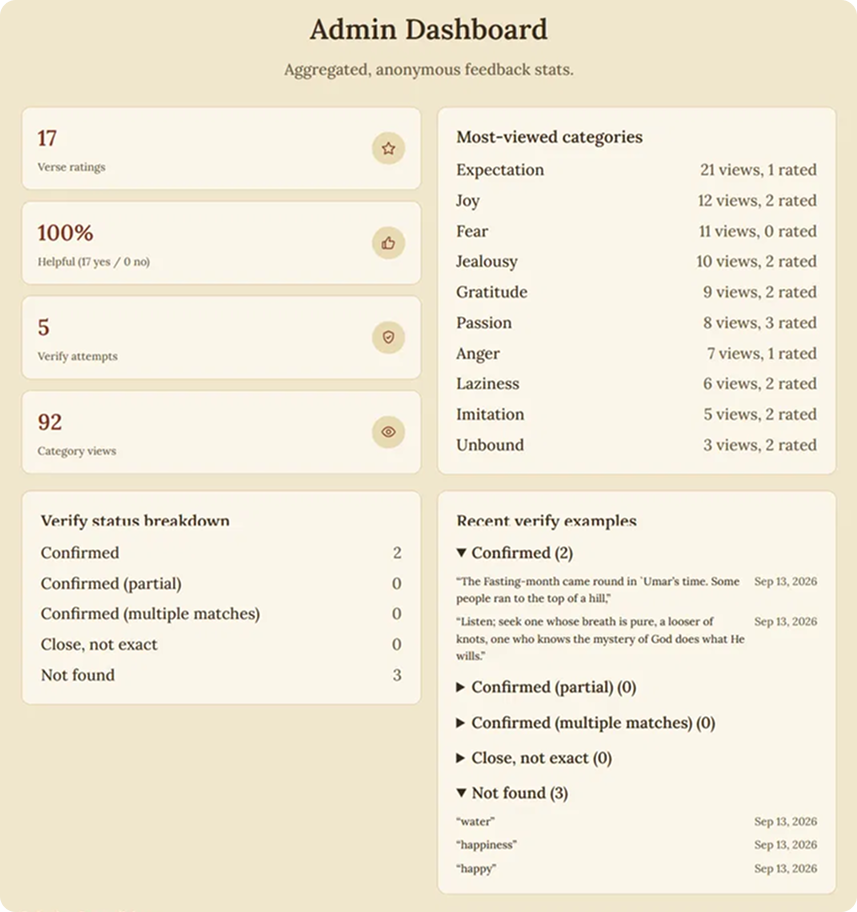
Real use then surfaced what self-testing could not: the category-verse mismatch, Verify used as search, and the logo note from a designer. Early signals are intentionally modest: 92 category views, 17 verse ratings, 100% helpful ratings, and 5 verification attempts.

92 category views 17 verse ratings 100% helpful 5 verifications
Admin dashboard showing aggregated, anonymous feedback stats: verse ratings, helpful percentage, verify attempts, category views, most-viewed categories, and verify status breakdown
The admin dashboard behind these numbers — aggregated, anonymous feedback from real use.

Final Design

Selected screens

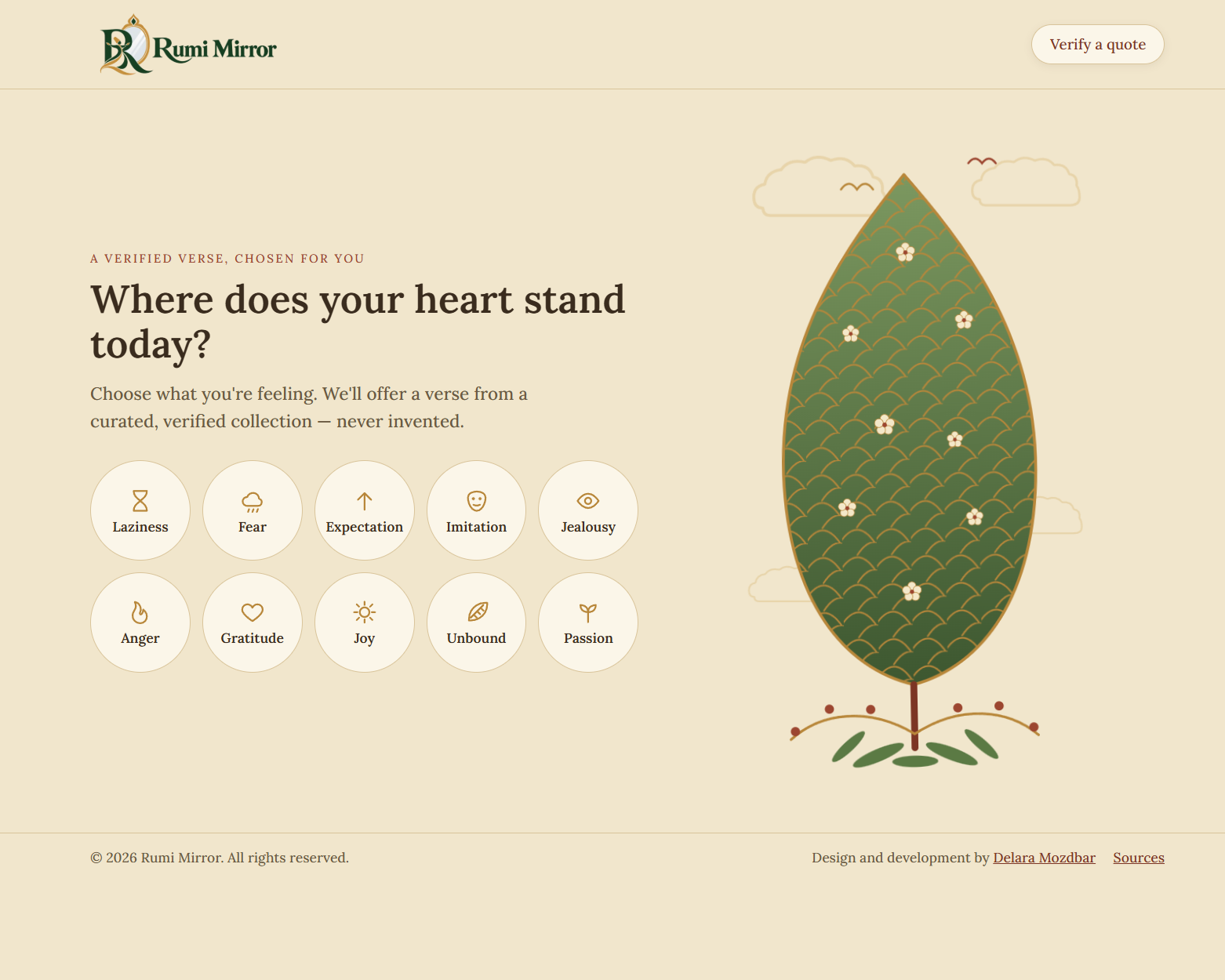
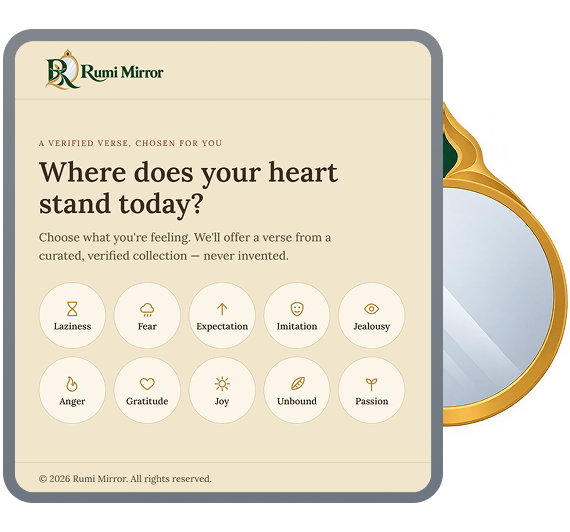
Home screen with ten emotional categories

Home — category selection

Ten emotional categories replace free-text input, so matching starts from a clear choice rather than an open prompt.

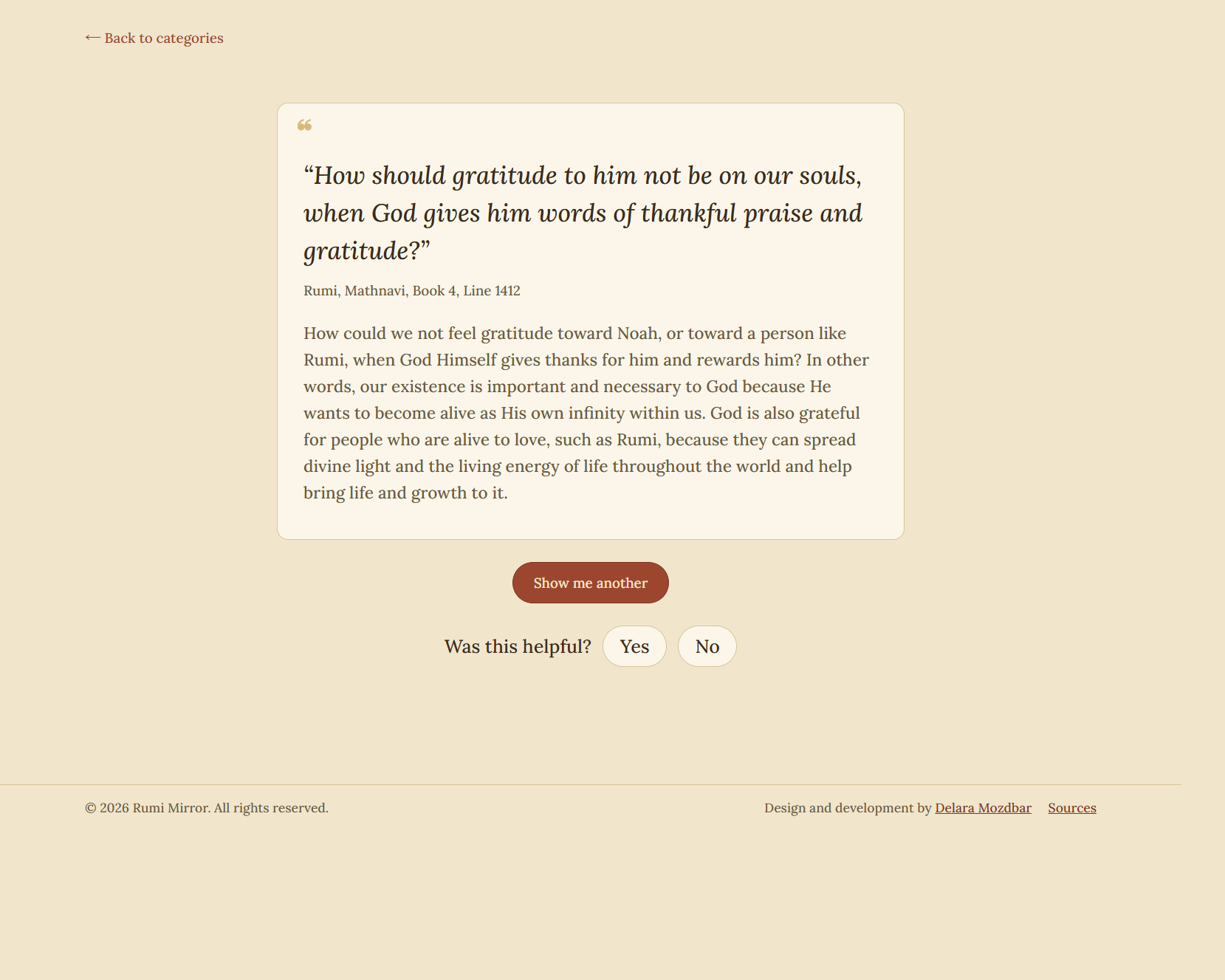
A verified verse with its book and line citation

Verse and reflection

Every verse is shown with its exact book and line. The reflection is human-authored, not generated by the model.

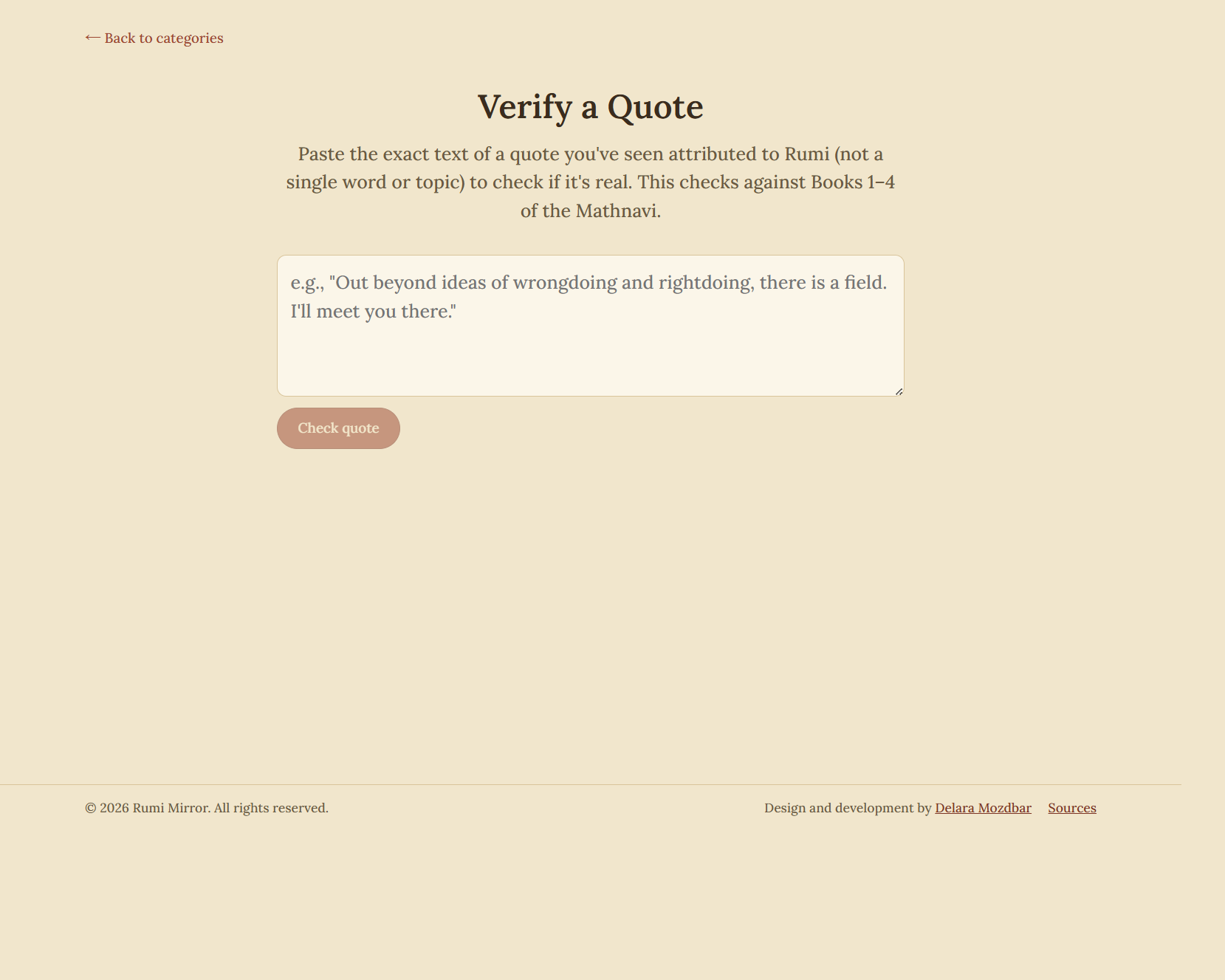
Verify a Quote screen

Verify a quote

Paste a quote attributed to Rumi and check it against Books 1–4 of the Mathnavi. The system states what it found, including when it found nothing.

Reflection

What I'd do differently

Five things that generalize beyond this product

  1. Explain the ethical value before presenting the interface.
  2. Make source credibility visible at the moment of use.
  3. Use constraints to reduce ambiguous AI behavior.
  4. Treat tester confusion as evidence, not as user error.
  5. Disclose the limits of both the dataset and the evaluation.

Where the evidence has clear boundaries

Verse translations are Reynold A. Nicholson's public-domain English translation of the Mathnavi, Books 1–4. Interpretations are Persian-language summaries of Parviz Shahbazi's teachings on the Ganj-e Hozour program, translated into English by the author. Trust is designed into the content model, not added as a disclaimer.

Generative AI (Claude, Anthropic) supported technical architecture, application code, wording, and the structure of the research log. Verse selection, citations, interpretations, and authenticity verdicts were reviewed by me for accuracy.

Read more View next case study